
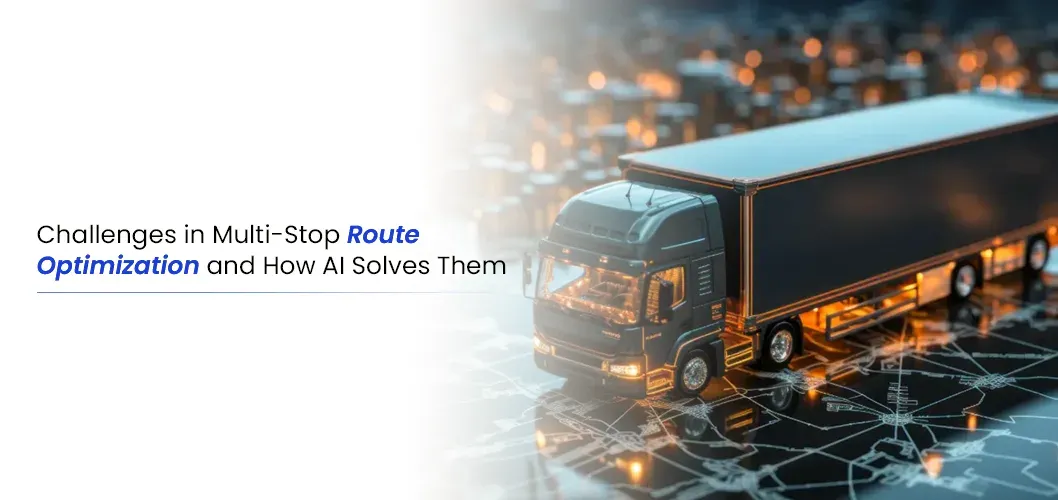
Challenges in Multi-Stop Route Optimization and How AI Solves Them

Introduction
The logistics game in America has changed. Fast.
Customers expect same-day delivery. Fuel prices swing without warning. Traffic jams swallow schedules whole. And fleet managers? They are stuck trying to coordinate dozens, sometimes hundreds, of deliveries across crowded urban grids and sprawling interstate networks. This is exactly the challenge that our solution solves.
That is where multi-stop route optimization stops being a luxury and becomes survival.
For modern logistics companies, route planning is no longer about finding the shortest distance between Point A and Point B. It is about balancing delivery windows, fuel costs, vehicle capacity, driver availability, weather disruptions, customer expectations, and real-time road conditions simultaneously. Human planners cannot process that level of complexity fast enough anymore.
AI can.
At Mobility Infotech Logistics, we believe the future of transportation belongs to businesses that embrace intelligent automation early. Smart routing is not just about operational efficiency. It is a competitive advantage.
Why Multi-Stop Route Optimization Is So Difficult
On paper, route planning sounds simple.
Assign deliveries. Build routes. Dispatch drivers.
Reality is messy.
A single delivery route may involve 20 to 100 stops, each with different priorities, time windows, package sizes, and geographic constraints. One traffic accident in downtown Chicago or Los Angeles can throw the entire schedule into chaos.
And then there is the famous “last mile.” The most expensive mile in logistics.
The challenge grows exponentially with every added stop. This is known in operations research as the Traveling Salesman Problem, where finding the absolute best route becomes computationally enormous as the number of variables increases.
Tiny changes create massive ripple effects.
One delayed driver can impact warehouse timing, customer satisfaction, fuel costs, labor expenses, and next-day scheduling.
No wonder logistics teams lose sleep over routing.
The Biggest Challenges in Multi-Stop Route Optimization
Traffic Congestion and Unpredictable Delays
American roads are crowded. Really crowded.
Urban congestion costs businesses billions every year in wasted fuel and delayed shipments. Traditional GPS systems often fail because they react too late. By the time a dispatcher manually adjusts routes, the damage is already done.
According to industry survey data, 69% of companies now make real-time routing adjustments due to delays and congestion pressures.
Static routes simply cannot keep up with dynamic road conditions anymore.
Rising Fuel Costs
Fuel remains one of the largest operational expenses in logistics.
Even small inefficiencies add up quickly across large fleets. A few unnecessary miles per route can translate into hundreds of thousands of dollars annually for mid-sized carriers.
Worse still, empty miles continue draining profits. Reports show roughly 35% of U.S. truck routes are driven without cargo.
That is wasted time. Wasted labor. Wasted fuel.
And honestly? It is unsustainable.
Complex Delivery Windows
Customers want precision now.
Not “sometime tomorrow.”
Not “between 9 AM and 6 PM.”
They want live ETAs, precise delivery times, and instant updates. Delays in delivery result in customer dissatisfaction, delivery failures, and higher customer support expenses.
Managing these expectations across dozens of stops manually becomes operational chaos.
Driver Shortages and Workforce Pressure
The U.S. trucking industry continues facing driver shortages, increasing pressure on existing fleets to do more with fewer resources.
Longer routes and inefficient schedules burn drivers out faster. Poor route planning also increases idle time, unnecessary waiting, and overtime expenses.
Drivers feel it immediately.
Lack of Real-Time Visibility
Many logistics companies still rely on outdated systems that provide limited visibility into fleet movement.
A dispatcher sees delayed deliveries but cannot proactively fix them. By the time corrective action happens, customer experience already suffers.
This reactive model no longer works in modern logistics.
How AI-Based Route Optimization Changes Everything
Now the interesting part.
Artificial intelligence transforms routing from a static planning exercise into a living, adaptive system.
Instead of relying on fixed assumptions, AI-based route optimization continuously analyzes data in real time and recalculates the best possible routes instantly.
It thinks dynamically.
- Traffic changes? AI reroutes automatically.
- Weather disruption? AI adjusts schedules.
- Unexpected cancellations? AI redistributes stops efficiently.
That level of responsiveness changes logistics economics completely.
Real-Time Decision Making
Traditional route planning tools mostly work before vehicles leave the warehouse.
AI works during the journey.
Modern AI systems process:
- Live traffic feeds
- Weather conditions
- Road closures
- Driver behavior
- Vehicle capacity
- Fuel consumption
- Delivery urgency
- Historical route performance
All simultaneously.
This allows logistics companies to make intelligent adjustments minute by minute instead of hour by hour.
According to recent logistics research, automated route optimization helps fleet managers save around seven hours of work weekly while reducing fuel budgets by nearly 20%.
Seven hours every week.
That is enormous operational leverage.
Smarter Multi-Stop Sequencing
One of AI’s biggest strengths lies in sequencing stops intelligently.
Humans often plan routes based on geography alone. AI sees much deeper patterns.
It understands:
- Traffic density by hour
- Customer delivery behavior
- Historical unloading times
- High-risk congestion zones
- Driver efficiency trends
This means routes become smarter over time.
Not just shorter.
Better.
A delivery scheduled for 4 PM may actually be more efficient at 1:30 PM once AI evaluates traffic and stop clustering patterns.
Humans rarely catch these optimizations consistently.
Reduced Empty Miles
Empty miles destroy profitability.
AI minimizes them by analyzing fleet-wide movement patterns and continuously matching loads with available nearby capacity.
Some AI logistics platforms have reported reducing empty miles by more than 70% in active freight networks.
That directly impacts:
- Fuel expenses
- Carbon emissions
- Vehicle wear
- Labor efficiency
- Revenue per mile
The environmental impact matters too. Freight logistics contributes significantly to greenhouse gas emissions, and AI-powered optimization could reduce logistics emissions by 10% to 15% through smarter routing and capacity planning.
Efficiency and sustainability now go hand in hand.
Predictive Intelligence Instead of Reactive Management
This is where modern route optimization tools become truly powerful.
AI does not only respond to disruptions.
It predicts them.
By analyzing historical and live operational data, AI systems can identify:
- Delay risks
- Congestion probability
- Vehicle maintenance issues
- High-risk delivery zones
- Driver fatigue patterns
That predictive capability gives logistics operators time to intervene before problems escalate.
And that changes everything operationally.
Better Customer Experience
Customers care about reliability.
Fast delivery matters. Predictable delivery matters even more.
AI-powered routing improves ETA accuracy significantly because routes adjust continuously based on actual conditions, not outdated assumptions.
Customers receive:
- More accurate delivery windows
- Real-time updates
- Faster response times
- Fewer missed deliveries
That consistency builds trust.
In today’s logistics market, trust drives retention.
Why U.S. Logistics Companies Are Investing Aggressively in AI
The American logistics sector is under intense pressure.
E-commerce growth continues to explode. Consumer expectations keep rising. Operational costs refuse to slow down.
That is why AI adoption is accelerating rapidly.
Recent surveys show 58% of U.S. fleet businesses already use automated route optimization technology.
And the broader market keeps expanding.
The U.S. route optimization market is projected to grow significantly as companies invest heavily in cloud-based AI logistics systems.
This is not a trend anymore.
It is infrastructure evolution.
The Future of AI-Based Route Optimization
The next generation of logistics AI will go even further.
We are moving toward autonomous decision ecosystems where routing systems communicate directly with:
- Warehouses
- Fleet management platforms
- Traffic systems
- Customer apps
- Inventory software
- Predictive maintenance systems
Everything becomes connected.
AI agents will soon optimize deliveries continuously across entire logistics networks with minimal human intervention.
And honestly, the companies that delay modernization risk becoming operationally obsolete.
Fast.
Why Mobility Infotech Logistics Believes AI Is the Future
At Mobility Infotech Logistics, we see AI-powered logistics not as a technology upgrade, but as a strategic transformation.
The future belongs to logistics businesses that:
- Reduce operational waste
- Improve delivery precision
- Lower fuel dependency
- Maximize fleet productivity
- Deliver exceptional customer experiences
Smart routing sits at the center of all of it.
Modern logistics requires systems that can think, adapt, and optimize in real time. Human planning alone cannot scale to today’s delivery demands.
AI can.
And the gap between companies using intelligent routing and those relying on outdated systems will only widen over the next few years.
Rapidly.
Get in touch with our battle-tested sustainability, technology, and TMS specialists to explore tailored green logistics solutions.

You might also like
 Written by Jane Austen
 Written by Michael S.
 Written by David Williams