
How Last Mile Routing Software Improves Delivery Accuracy and ETAs

Introduction
The clock is ticking. Somewhere in Dallas, a customer just refreshed their tracking page for the seventh time this hour, wondering if their package will actually arrive in the promised two-hour window or if they’re about to file another complaint. This single moment, repeated millions of times daily across America, is exactly where logistics either wins or loses. And honestly? The difference between a five-star review and a churned customer often boils down to one unsexy backend technology: last mile routing software.
Let’s talk about why that matters more than ever in 2026.
The Last Mile Is Still the Hardest
Here’s a number that should make every logistics manager sit up straight. The last mile accounts for roughly 53% of total shipping costs in the United States, according to most industry benchmarks. That’s wild. You can have a beautifully optimized cross-country freight system, perfectly tuned warehouses, and the cheapest fuel contracts in the country, and still hemorrhage profit on those final few miles between the distribution hub and Mrs. Johnson’s porch in suburban Atlanta.
Why does it cost so much? Stops are dense and unpredictable. Traffic is chaos. Drivers make split-second decisions. Customers reschedule. Apartment complexes have weird gate codes. The list goes on forever.
This is where modern routing technology stops being a “nice to have” and becomes survival gear.
What Does Last Mile Routing Software Actually Do?
Think of it as a tireless logistics genius riding shotgun with every driver in your fleet. It absorbs thousands of data points per second, including order volumes, delivery windows, vehicle capacity, driver skills, traffic patterns, weather, customer preferences, and historical performance, and then it produces a route that no human dispatcher could match.
Sounds dramatic? Maybe. But it’s accurate.
At Mobility Infotech Logistics, our AI-native engine factors in 200+ constraint parameters when generating routes for hundreds of riders handling thousands of orders. Manual planning simply cannot compete. The math is too complex for clipboards and gut feelings.
Where Delivery Accuracy Goes to Die (And How Software Saves It)
Picture this scenario. A mid-sized e-commerce brand in Phoenix grows 40% in one quarter. Suddenly the dispatcher who hand-built routes on a whiteboard every morning is drowning. Drivers double-back. Stops get missed. Returns pile up. Customers get the wrong package. Sound familiar?
That’s the accuracy crisis. And it’s not because anyone is incompetent. It’s because volume outpaced visibility.
Here’s how smart routing fixes the chaos:
Address verification before the route is even built.
Bad addresses are silent killers. The software cross-references geocoded data, flags incomplete entries, and corrects them upstream so drivers aren’t squinting at “Apartment B” in a five-building complex.
Constraint-aware sequencing.
Refrigerated items need shorter stops. Fragile items need careful drivers. High-value items need signatures. The software stacks deliveries in the only correct order, factoring in all of these.
Driver-specific intelligence.
Some drivers know certain ZIPs cold. Others are faster on highways than on residential grids. Good routing software learns and assigns accordingly.
The result? Fewer misdeliveries. Higher first-attempt success rates. Less reverse logistics chaos.
ETAs That Customers Actually Trust
Quick story. A few years ago, “your package will arrive between 8 AM and 8 PM” was acceptable. Today? That window is laughably bad. Amazon trained the American consumer to expect minute-level precision, and now every other shipper has to match it or get crushed.
This is where last mile delivery tracking software earns its keep.
Modern ETA engines don’t just predict arrival times. They re-predict them continuously. Every time a driver moves, every time traffic shifts on I-95, every time a stop takes longer than expected, the system recalculates and pushes updated estimates to customers in real time.
Customers stop calling support. Drivers stop fielding angry texts. Operations breathe easier.
How accurate are we talking? Best-in-class systems now hit ETA accuracy within a 10-minute window for over 90% of urban deliveries. Pretty remarkable when you consider the variables involved.
Real-Time Route Optimization: The Quiet Game-Changer
Static routes are dead. Long live the living, breathing route.
Static planning means you build the route at 6 AM and pray nothing changes. Spoiler alert: everything changes. A truck breaks down on the 405. A customer cancels mid-route. A new urgent order drops in from a VIP account. A snowstorm closes a bridge in Buffalo.
Real-time route optimization is the technology that responds to all of that, instantly. It pulls live traffic, weather, vehicle telemetry, and order updates, then re-sequences the remaining stops on the fly. Drivers receive new instructions seamlessly through their mobile app. No phone calls. No confusion.
What does this look like in dollars and cents? One of our USA-based clients, BlueHarbor Foods, reported significant fuel savings and reduced driver hours after switching to dynamic routing. Their VP of Logistics called it the best ROI decision of the year.
That tracks.
Why USA Logistics Operations Need This Yesterday
The American delivery landscape is uniquely brutal. Massive geography. Wildly varied infrastructure. Urban density that crashes against rural sprawl. Weather extremes from Florida humidity to Minnesota blizzards. Add labor shortages, rising fuel costs, and consumer expectations climbing every quarter, and you get a perfect storm.
You cannot brute force your way through this with more trucks and more drivers. The math doesn’t work. The only sustainable path forward is software-driven intelligence.
A few areas where U.S. fleets see immediate wins:
Fuel efficiency. Smart routing trims unnecessary miles. Every gallon saved is margin protected.
Driver retention. Drivers hate chaotic schedules. Good routing reduces stress and burnout.
Customer satisfaction. Accurate ETAs and on-time deliveries lift Net Promoter Scores fast.
Compliance. Hours-of-service rules, temperature logs, and signature capture are all simplified.
Scalability. When your peak season hits, software scales. Headcount cannot.
The Hidden Benefits Nobody Talks About
Want to know a secret? The data exhaust from routing software is almost as valuable as the routes themselves.
Every delivery becomes a data point. Patterns emerge. Maybe Tuesday afternoons in Brooklyn always run 22% slower than Monday afternoons. Maybe a certain carrier consistently underperforms in zip code 30309. Maybe customers in suburban Texas prefer evening windows over morning ones.
This intelligence compounds. Month after month. Quarter after quarter. The operations team gets smarter, faster, leaner, simply by paying attention to what the software surfaces.
That’s the long game. And it’s a beautiful one.
What Sets Mobility Infotech Logistics Apart
We’re not just throwing algorithms at problems. Our platform is built for purpose, designed to flow. AI-native route optimization. End-to-end logistics orchestration. Smart carrier management. Seamless integrations with SAP, Oracle, NetSuite, Microsoft Dynamics, and pretty much any OMS or TMS you can name.
Real customers tell us their last-mile chaos transformed into smooth, measurable operations. Delivery delays cut by nearly 28%. Customer complaints down dramatically. ERP integration handled in weeks, not months.
That’s the standard. Anything less is leaving money on the table.
Ready to Stop Guessing?
If your dispatcher is still printing routes off a spreadsheet, your customers are noticing. If your ETAs are wider than a six-lane highway, your reviews are slipping. If your fuel costs keep climbing while your delivery counts stay flat, something is broken.
Fix it. Then watch what happens.
Curious how Mobility Infotech Logistics can transform your last-mile operations? Visit Mobility Infotech Logisitcs book a consultation. A dedicated team member will reach out within 24 hours to design a customized, data-driven logistics plan built for your business.
Get in touch with our battle-tested sustainability, technology, and TMS specialists to explore tailored green logistics solutions.

You might also like
 Written by Jane Austen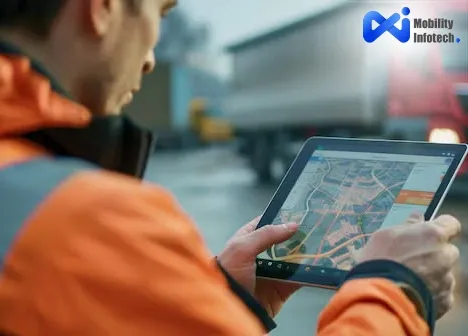
 Written by Michael S.
 Written by David Williams