
Reducing Empty Miles and Delivery Delays with Data-Driven Route Optimization Tools

Introduction
The American landscape is a massive web of highways, and for the logistics industry, it is the lifeblood of the nation. From the ports of Long Beach to the warehouses of the Midwest, the movement of goods has never been more critical. In 2026, the U.S. freight and logistics market is expected to reach a staggering $1.43 trillion. But with this massive scale comes an equally large challenge: how do we stop wasting miles and losing time?
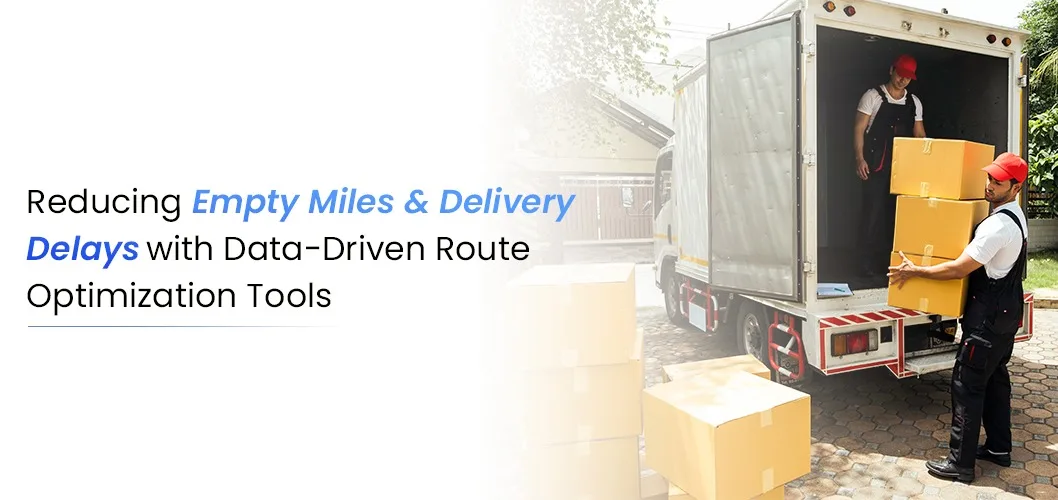
For many fleet owners across the country, the two biggest profit killers are empty miles and delivery delays. Empty miles, or "deadhead" trips, happen when a truck moves without a load, burning fuel and time for zero return. Delivery delays occur when traffic, weather, or poor planning stall a shipment. To fight back, the industry is turning to Route Optimization Tools. These smart systems use data to find the most efficient paths, ensuring that every mile driven adds value to the bottom line.
The Problem of Empty Miles in U.S. Logistics
An empty truck is a drain on resources. Recent industry data from Mordor Intelligence shows that while the market is growing, operational costs are also on the rise. Without route optimization, companies often struggle with trucks returning empty after a drop-off.
In a country where diesel prices fluctuate and driver shortages are a constant concern, driving an empty rig is an expense no business can afford. According to the American Trucking Associations (ATA), trucks move over 11 billion tons of freight annually. By using Route Optimization Tools, carriers can better coordinate "backhauls"—picking up a new load near the delivery site—to keep the wheels turning with cargo. This shift doesn't just save money; it helps meet federal sustainability goals by cutting down on unnecessary fuel burn and emissions.
Solving Delivery Delays with Smart Tech
Whether it is a snowstorm in the Rockies or a massive gridlock in Atlanta, delays are a daily reality on U.S. roads. The Bureau of Transportation Statistics (BTS) tracks the Freight Transportation Services Index, which shows how sensitive the industry is to shifts in demand and road conditions.
This is where real-time route optimization changes the story. Unlike static maps, these tools use live data feeds from the U.S. Department of Transportation (DOT) and other sensors to see ahead. If there is a major wreck on I-95, the software alerts the driver to a faster bypass before they reach the backup. The DOT’s goal is to maintain a Truck Travel Time Reliability (TTTR) index of 1.43 or lower through 2026. By using these tools, private fleets can meet these high standards and keep their "on-time" promises to customers.
Why Data-Driven Tools are the Future
The U.S. government is investing heavily in the "Freight Logistics Optimization Works" (FLOW) initiative. This program aims to share data across the supply chain to speed up movement at ports and on highways. For any logistics firm, using route optimization software is the best way to plug into this data-rich future.
By the end of this decade, experts predict that AI-driven fleet management could boost weekly truck revenue by up to 24%. Using Route Optimization Tools allows a manager in an office to see the entire fleet across multiple states on a single dashboard. You can track which driver is ahead of schedule, which truck is currently empty, and where you can cut idle time to save on costs.

Stats and References for U.S. Logistics
To see why efficiency matters so much in today's market, look at these facts from leading U.S. authorities:
- Market Value: The U.S. freight and logistics market is projected to grow to $1.43 trillion by 2026 (Mordor Intelligence).
- Industry Revenue: The trucking industry alone accounts for over $900 billion in gross freight revenues (American Trucking Associations).
- Efficiency Gains: AI-powered route planning can reduce travel distance by 10% to 30%, significantly lowering exhaust emissions (AsstrA Logistics Report).
- Road Reliability: The U.S. DOT has set a target to keep truck travel reliability high, aiming for a TTTR Index of 1.43 through the 2026 fiscal year (U.S. Department of Transportation).
- Automation Growth: Logistics automation is expected to reach nearly $89 billion by 2026, as more firms move away from manual planning (Procurement Tactics).
Benefits for U.S. Based Fleets
- Drastic Fuel Savings: Less time idling and shorter paths lead to a smaller fuel bill.
- Maximized Capacity: Fill every truck for every mile to grow your revenue.
- Driver Retention: Better routes mean less time stuck in traffic, making for happier drivers.
Environmental Impact: Lower your carbon footprint to stay ahead of new "green" regulations.
How Mobility Infotech Logistics Helps You Lead
At Mobility Infotech, we understand the unique challenges of the U.S. interstate system. From coast-to-coast hauls to dense urban last-mile deliveries, our real-time route optimization solutions are built to handle the scale. We help you turn complex traffic data and load boards into simple, actionable routes.
With the U.S. logistics market expanding every day, staying still means falling behind. Don't let empty miles hold your business back. Use route optimization to sharpen your fleet and deliver faster, smarter, and cheaper than the competition.

Final Thoughts
The days of relying on intuition and paper maps are over. As the U.S. moves toward a more connected and data-heavy supply chain, the ability to stop empty miles and prevent delays is the only way to stay profitable. By adopting Route Optimization Tools by Mobility Infotech Logistics, your company isn't just buying software; it is gaining a strategic partner. In 2026, the winners in the American logistics market will be those who use data to drive every single mile.
- content
- Introduction
- The Problem of Empty Miles in U.S. Logis...
- Stats and References for U.S. Logistics
- How Mobility Infotech Logistics Helps Yo...
- Final Thoughts
Get in touch with our battle-tested sustainability, technology, and TMS specialists to explore tailored green logistics solutions.

You might also like
 Written by Jane Austen
 Written by Michael S.
 Written by David Williams