
The Future of Logistics Routing Software: AI, Automation, and Real-Time Optimization

Introduction
The logistics landscape is evolving rapidly, and for delivery businesses in the USA, traditional methods are no longer sustainable. Customers want their packages now. Fuel costs are up and down. Traffic is worse than ever.
How do we keep up? The answer lies in the next generation of logistics software. We are moving away from simple maps and moving toward smart systems. At Mobility Infotech Logistics, we see the shift every day. The future is not just about a driver getting from A to B. It is about AI, automation, and making decisions in the blink of an eye.
The Reality on the Ground
Before we talk about the high-tech stuff, let's talk about the real world. A computer might say a route takes twenty minutes. But a driver knows that the school zone at 3 PM will turn that into forty minutes. A computer might not know that a certain loading dock is broken.
The biggest challenge in logistics today is the gap between the screen and the street. Many companies sell flashy tools that look great in a demo. But when the rain starts falling, and three drivers call in sick, those tools often fail.
The future of logistics routing software is about bridging that gap. It is about building tools that understand the messy reality of the American road. It is about software that learns from the driver instead of just giving orders.
Why AI is the New Co-Pilot
Artificial Intelligence (AI) is a big word, but its job is simple. It looks at patterns. In the past, routing software was static. You put in ten stops, and it gave you a line to follow. If a crash happened on the highway, you were stuck.
Modern AI does not just sit there. It watches. It seems that traffic is building up on I-95 before the news even reports it. It can predict that a certain neighborhood will have more deliveries on a Friday than on a Tuesday.
For a logistics software company, the goal is to make AI feel like a smart co-pilot. It helps the dispatcher make better choices. It suggests new paths. It keeps the wheels turning so the business does not lose money on idle time.
The Power of Real-Time Optimization
Real-time optimization is the "secret sauce" of modern delivery. Imagine a truck is halfway through its route. A new, urgent order comes in. In the old days, that order would wait until tomorrow.
With real-time tools, the software recalculates everything in seconds. It checks which truck is closest. It checks who has enough space. It sends the update to the driver’s phone instantly.
This level of speed is what wins customers today. People are used to seeing their pizza or their ride-share car move on a map in real time. They expect the same for their business deliveries and home packages. If you can't optimize on the fly, you are falling behind.
Final-Mile Logistics: The Final Frontier
The hardest part of any journey is the last few miles. This is what we call Final-Mile Logistics. It is also the most expensive part. It involves tight turns, narrow driveways, and finding the right door in a huge apartment complex.
Automation is stepping in to help here. We are seeing software that can tell a driver exactly where to park to save sixty seconds. Those seconds add up. If you have fifty drivers and each saves ten minutes a day, you just found a lot of extra profit.
The future of final-mile logistics work is about precision. It is about using data to make sure the truck is loaded in the right order. No driver should have to dig through a mountain of boxes to find the one for the current stop. The software should know where every box is.
The Growth of White Label Logistics Software
Not every company has the budget to build its own tech from scratch. It costs millions of dollars and takes years. This is why white label logistics software is becoming so popular in the USA.
A white-label solution lets a business take a powerful, proven platform and put its own brand on it. You get the AI, the real-time tracking, and the smart routing, but it looks like your own tool.
This levels the playing field. It allows small and mid-sized carriers to compete with the giants. You don't need a team of a thousand coders. You just need the right partner to provide the engine while you drive the van.
Keeping It Simple
As we look ahead, the best final mile logistics software will not be the one with the most buttons. It will be the one that is easiest to use. Drivers are busy. They do not want to click through ten screens to log a delivery. Dispatchers are stressed. They do not want to look at messy charts.
At Mobility Infotech Logistics, we believe the best tech feels like it isn't even there. It just works. It makes the day go faster. It makes the customers happier. And most importantly, it makes the business more money.
Get in touch with our battle-tested sustainability, technology, and TMS specialists to explore tailored green logistics solutions.

You might also like
 Written by Jane Austen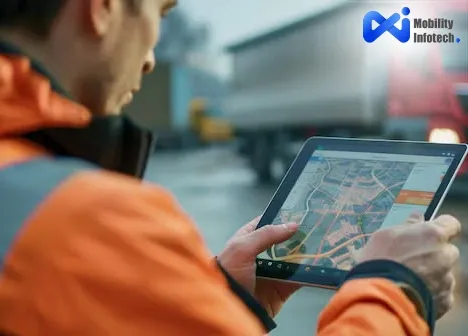
 Written by Michael S.
 Written by David Williams