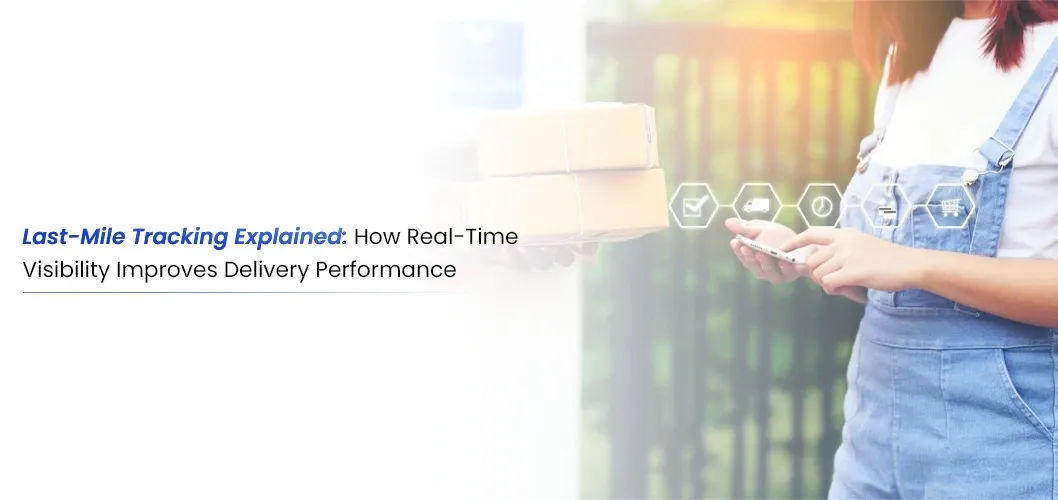
Last-Mile Tracking Explained: How Real-Time Visibility Improves Delivery Performance

Introduction
The last mile is short. But it is also the most expensive, unpredictable, and customer-facing part of any delivery. A package can travel thousands of kilometres without issue. Then it fails in the final few. That is why last-mile tracking has become one of the most important capabilities in modern logistics.
So, what makes last-mile tracking work? And how does real-time visibility actually change delivery outcomes for businesses and customers? Explained simply, last-mile tracking gives businesses greater control, improves customer communication, and helps ensure successful deliveries.
What Is Last-Mile Tracking?
Last-mile tracking is the process of monitoring a shipment from the time it leaves a local hub or warehouse until it reaches the customer's door. It uses GPS, IoT sensors, mobile apps, and cloud platforms to give live location updates at every step.
It sounds simple. But there is a lot happening under the hood.
Key Components of a Last-Mile Tracking System
- GPS-enabled driver apps track vehicle location in real time, allowing dispatchers to see exactly where each delivery agent is at any given moment.
- Automated customer notifications send SMS or email alerts at key stages, such as "Out for Delivery" or "Delivered," reducing inbound support calls significantly.
- Proof of delivery (POD) capture lets drivers collect digital signatures or photos on their phones, creating a time-stamped delivery record for both business and customer.
- Exception alerts flag problems like failed deliveries, route deviations, or long idle times so dispatchers can act fast before delays escalate.
- Live tracking links shared with customers give them a real-time view of their delivery, much like a ride-hailing app, which builds trust and reduces anxiety.
Why Does Last-Mile Tracking Matter So Much?
Have you ever wondered why so many customers abandon brands after just one bad delivery experience?
Research published by the MIT Center for Transportation and Logistics found that last-mile delivery accounts for up to 53% of total shipping costs. At the same time, a report by Convey (now project44) found that 84% of customers will not return to a brand after one poor delivery experience.
These numbers tell the story clearly. Poor last-mile performance does not just cost money. It costs customers.
Real-time visibility directly addresses this by:
- Reducing failed deliveries: Customers who know when to expect their order are more likely to be present. Failed first-attempt deliveries cost carriers an average of $17.20 per reattempt in the United States, according to research by SEKO Logistics.
- Improving driver accountability: When routes and movements are tracked live, drivers stay on schedule and follow planned routes more consistently.
- Enabling faster exception management: Issues like traffic, breakdowns, or wrong addresses can be resolved in real time instead of after the fact.
- Giving businesses data to improve: Every delivery generates data. Over time, this data reveals patterns in delays, fuel use, and customer satisfaction.
How Real-Time Visibility and Route Optimization Work Together
Tracking alone is not enough. What transforms visibility into performance is combining it with smart routing.
This is where real-time delivery route optimization becomes critical. Instead of planning routes once in the morning and hoping for the best, modern systems adjust routes continuously as conditions change. A traffic jam, a new order added mid-route, or a failed delivery can all trigger an automatic re-routing recommendation.
Mobility Infotech Logistics builds exactly this kind of intelligence into its platform. The system processes over 200 constraint parameters, including time windows, vehicle capacity, driver shift limits, and traffic data, to generate optimised routes in seconds. As a result, clients have reported delivery delay reductions of nearly 28% after adopting the platform.
"The companies that will win in logistics are those that can sense what is happening in real time and act on it instantly. Visibility without action is just data." — Dr. Yossi Sheffi, Director, MIT Centre for Transportation and Logistics
This quote captures why last mile route optimization software matters so much. Seeing a delay is only useful if the system can also fix it.
The Role of Last Mile Route Optimization Software
Can a business truly improve delivery performance without dedicated software? It is possible on a small scale. But as delivery volumes grow, manual planning breaks down fast.
Last mile route optimization software does several things that manual planning simply cannot:
- Handles thousands of stops at once: A dispatcher cannot manually calculate the best sequence for 200 deliveries across a city. Software can do it in seconds.
- Accounts for real-world constraints: Delivery windows, vehicle load limits, driver breaks, restricted zones, and customer preferences all need to be factored in together.
- Learns from past data: AI-powered systems identify patterns, such as which areas have consistent delays or which time slots have the highest first-attempt success rates, and use this to improve future routing.
- Reduces fuel costs: Shorter, smarter routes mean less fuel per delivery. The U.S. Department of Energy reports that route optimisation can reduce fleet fuel consumption by up to 20%.
- Scales with volume: Whether a business handles 50 deliveries or 5,000, good route optimization for last-mile delivery scales without requiring proportionally more staff.
Mobility Infotech Logistics uses AI-native route planning that processes multi-stop, multi-driver scenarios with live updates, making it one of the strongest tools available for high-volume delivery operations today.
Real-Time Visibility by the Numbers
Here are some lesser-known but important statistics that show just how much tracking and route optimisation matter:
- The global last-mile delivery market was valued at USD 131.6 billion in 2023 and is projected to reach USD 424.3 billion by 2030, growing at a CAGR of 18.1%, according to Grand View Research.
- A study by McKinsey & Company found that urban last-mile delivery failures cost businesses and carriers globally an estimated USD 20 billion per year.
- According to Statista, 56% of online shoppers in the U.S. have abandoned a purchase because of unsatisfactory delivery options.
- Route optimization for last mile delivery has been shown to cut average delivery times by up to 30% in high-density urban environments, per a study published in the Journal of Business Logistics.
- Only 26% of companies currently use real-time tracking across their last-mile operations, despite it being one of the highest-ROI logistics investments available, according to a Gartner Supply Chain Survey.
That last number is striking. Most companies are still leaving significant performance gains on the table.
What Good Last-Mile Tracking Looks Like in Practice
What separates basic tracking from genuinely effective last-mile visibility?
Here is what a well-built system delivers:
- Live ETA updates that adjust dynamically as routes change, not just static time windows given at the point of dispatch.
- Two-way communication between driver and customer, so small issues like incorrect address details can be sorted before the driver arrives.
- Geo-fenced triggers that automatically send notifications when a driver enters a defined radius around the delivery address.
- Delivery route optimization built into the same platform as tracking, so data flows between planning and execution without manual steps.
- Historical analytics dashboards that allow managers to review performance by driver, route, zone, and time period.
Mobility Infotech Logistics integrates all of these capabilities into a single platform. Clients gain not just tracking but a full picture of delivery performance, from dispatch to doorstep.
Common Challenges in Last-Mile Tracking (and How to Solve Them)
Even with good technology, some challenges persist. Here are a few, and how smart systems address them:
- Urban congestion and density: Cities create unpredictable delays. Last mile route optimization software that uses live traffic data and re-routes in real time significantly reduces the impact of urban congestion.
- Proof of delivery disputes: Without digital POD, businesses have no evidence of delivery. Photo capture and digital signatures, time-stamped and geo-tagged, resolve this cleanly.
- Driver app adoption: Complicated apps slow drivers down. The best platforms keep the driver-side interface simple: one screen, clear next steps, and minimal taps.
- High package density in apartments and gated communities: These locations require additional planning steps. Systems that allow drivers to add notes and flag complex locations help future deliveries to the same address.
- Customer unavailability: Predictive analytics can identify high-risk delivery windows and suggest alternatives before dispatch, reducing failed attempts at source.
- content
- Introduction
- What Is Last-Mile Tracking?
- How Real-Time Visibility and Route Optim...
- Real-Time Visibility by the Numbers
- Common Challenges in Last-Mile Tracking ...
Get in touch with our battle-tested sustainability, technology, and TMS specialists to explore tailored green logistics solutions.

You might also like
 Written by Jane Austen
 Written by Michael S.
 Written by David Williams