
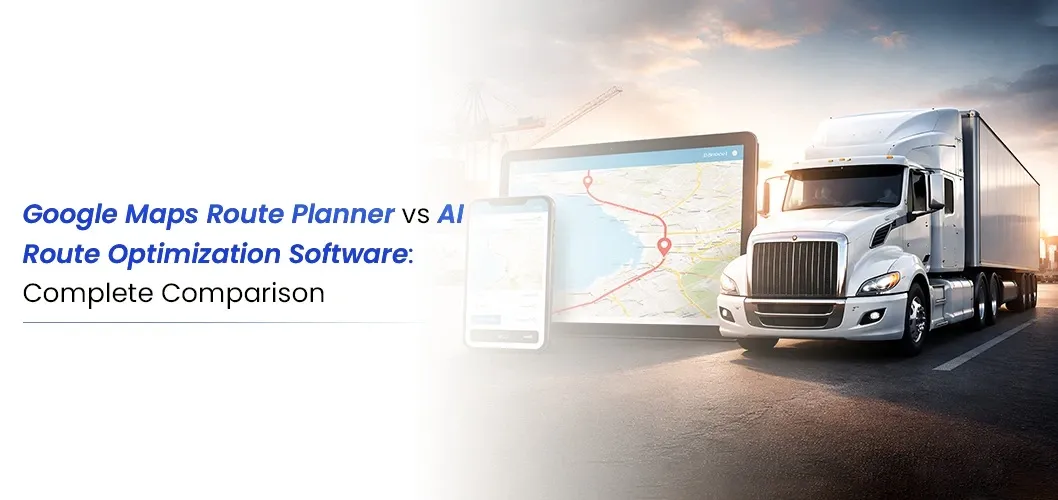
Google Maps Route Planner vs AI Route Optimization Software: Complete Comparison

Introduction
Every delivery business in the USA starts in the same place. A driver, a list of addresses, and Google Maps open on a phone. It feels free, familiar, and good enough. Until one day it is not. Orders grow, stops multiply, and the tool that got you started begins to cost you money you cannot see. That is the moment thousands of American businesses face every year, and it is exactly the choice this guide will help you make: stick with a free maps route planner or move up to dedicated route optimization software.
At Mobility Infotech Logistics, we talk to fleet owners across the USA every week who are stuck at this crossroads. So let us break it down honestly, with real numbers, and show you where each tool wins.
What Google Maps Does Well
Let us give credit where it is due. Google Maps is the most widely used navigation app in America, and for good reason. As a basic route planner, it is fast, free, and works on every phone. It shows live traffic, suggests faster paths, and gets a single driver from point A to point B without drama.
If you run one vehicle, make a handful of stops a day, and your delivery schedule rarely changes, a maps route planner may genuinely be all you need. There is no shame in that. Smart businesses use free tools for as long as those tools serve them.
The problem starts when your business outgrows the tool. And most delivery businesses outgrow it much sooner than they expect.
Where Google Maps Hits a Wall for Businesses
1. The 10-stop ceiling
Google Maps caps every route at 10 stops. A typical last-mile driver in the USA handles 80 to 150 stops a day. That means your dispatcher is manually breaking one route into a dozen fragments, guessing at the best order, and pasting addresses one by one. That is not planning. That is data entry.
2. It optimizes a trip, not a business
A maps route planner answers one question: what is the fastest way to the next stop? Route optimization software answers a much bigger one: what is the most profitable way to complete every stop, across every driver, for the entire day? Google Maps cannot see your other trucks. It does not know that two of your drivers are about to cross paths in the same zip code, wasting fuel and hours.
3. No business rules
Delivery windows. Vehicle capacity. Driver shift limits. Customer priority levels. Bridge heights for box trucks. Google Maps considers none of it. One missed delivery window can cost you a customer, and in a market where last-mile delivery already eats up roughly 53% of total shipping costs, there is no room for avoidable mistakes.
4. Zero visibility and zero proof
With Google Maps, a dispatcher has no idea where the fleet is. Customers call asking where their package is, and the answer is a phone call to the driver. No live ETAs. No proof of delivery. No reports at the end of the day telling you what a route actually cost.
What AI Route Optimization Software Brings to the Table
Modern route optimization software is not a bigger map. It is a decision engine. Platforms like the one built by Mobility Infotech Logistics analyze hundreds of variables at once, including live traffic, delivery windows, vehicle capacity, driver hours, and demand patterns, then produce the most efficient plan for your entire fleet in minutes.
And it does not stop when the trucks leave the yard. When traffic builds up on I-95 or a customer changes a delivery slot, the system recalculates on the move and pushes the new plan straight to the driver's phone. Dispatchers see every vehicle live. Customers get accurate ETAs automatically. Managers get reports that show exactly where money is being made or lost.
This is the real difference. A route planner reacts. AI route optimization software predicts, learns from every completed trip, and gets smarter each week.
The Numbers USA Businesses Should Know
The financial case is hard to ignore. Studies show businesses using advanced route optimization software can cut fuel consumption by up to 30%. Traffic congestion alone costs the American trucking industry more than 100 billion dollars every year, and manual planning leaves fleets exposed to every minute of it.
The gains show up fast in daily operations too. AI-driven planning can boost dispatch speed by up to 80%, and companies using the Mobility Infotech Logistics platform have reported delivery accuracy improvements of 30% along with a significant cut in operational overhead. Even a small fleet feels it. Saving ten miles per truck per day adds up to thousands of dollars a year, per vehicle.
Free is only free until you count the fuel, the overtime, the missed windows, and the customers who quietly moved to a competitor with live tracking.
So Which One Should Your Business Choose?
Here is the honest answer. Choose Google Maps if you run one or two vehicles, make fewer than 10 stops a day, and your customers do not expect live updates. It is a solid free route planner for simple, low-volume operations.
Choose AI route optimization software if any of this sounds familiar: your dispatcher spends hours building routes by hand, your drivers overlap in the same areas, customers keep calling for ETAs, fuel bills keep climbing, or you are turning down growth because planning cannot keep up. These are the classic signs that a free maps route planner has quietly become the most expensive tool in your business.
Why Growing Fleets Choose Mobility Infotech Logistics
Mobility Infotech Logistics builds route optimization software around the real pain points of American delivery operations, not around flashy dashboards nobody uses. The platform combines AI-powered route planning, live fleet tracking, automated dispatch, proof of delivery, and customer notifications in one place, and it integrates with the ERP and order systems you already run. Implementation is fast; the driver app takes minutes to learn, and the analytics help you make smarter decisions every single week.
The delivery market in the USA is only getting faster and tighter. The businesses that win the next decade will be the ones that stopped planning like it was 2015. If the 10-stop ceiling is holding your fleet back, talk to the experts at Mobility Infotech Logistics today and see exactly how much your current routes are costing you.
- content
- Introduction
- What Google Maps Does Well
- What AI Route Optimization Software Brin...
- The Numbers USA Businesses Should Know
- Why Growing Fleets Choose Mobility Infot...
Get in touch with our battle-tested sustainability, technology, and TMS specialists to explore tailored green logistics solutions.

You might also like
 Written by Jane Austen
 Written by Michael S.
 Written by David Williams