
12 Must-Have Features of the Best Last Mile Delivery Software in 2026

Introduction
Every last mile software demo looks the same. A clean dashboard, a map full of moving dots, a confident sales engineer saying the word “optimise” every forty seconds. Then the contract gets signed, peak season arrives, and the differences that never showed up in the demo start showing up on your P&L.
That gap between the demo room and the loading dock is exactly why this guide exists. The last mile is not a place to guess. Cascadia data published by Statista in January 2024 puts last mile delivery at 53% of total shipping costs, up from 41% in 2018. The Capgemini Research Institute has warned that businesses running suboptimal delivery models can watch profits erode by as much as 26% over three years. And a 2024 CNBC survey found that 85% of retail shippers named cutting cost per order as their single biggest last mile priority.
So instead of another flat feature list, here is a buyer’s scorecard. Twelve features, sorted into three tiers by what they actually protect: your operation, your margin, and your growth. The best last mile delivery software in 2026 clears all three.
Tier One: The Non-Negotiables
If a platform misses any of these five, walk away. No pricing discount fixes a structural gap.
1. AI Route Optimisation That Recalculates Mid-Route
Static morning routes died the moment same-day delivery went mainstream. The US same-day delivery market hit $9.25 billion in 2024 and is projected to reach $13.15 billion by 2030. Your software must re-sequence stops in real time as traffic, cancellations, and new orders hit the system. McKinsey research pegs the payoff at 10% to 25% in delivery cost reductions when routing is treated as a live, multi-constraint problem rather than a printed plan. Ask the vendor one question: “What happens to the route at 2 PM when three orders cancel and five get added?” If the answer involves a dispatcher doing it manually, that is not optimisation. That is a map.
2. Real-Time Tracking on a Branded Page
Customers do not want a carrier’s generic tracking link. They want your brand, your colours, and a live dot on a map. This is also where last mile delivery management quietly becomes a marketing channel, because every tracking page view is a brand impression you did not pay for.
3. Automated Dispatch and Driver Assignment
Manual dispatching caps your growth at whatever one stressed human can hold in their head. Rules-based auto-assignment by zone, vehicle capacity, driver skill, and delivery window should happen in seconds, not standup meetings.
4. Electronic Proof of Delivery
Photo, signature, geotag, timestamp. All four, captured in one tap. In 2026, ePOD is less about record keeping and more about dispute defence, because “the package never arrived” claims get settled by data, not arguments.
5. Predictive ETAs Customers Can Actually Trust
A vague “arriving today” window is a missed delivery waiting to happen. Machine learning ETAs that narrow as the driver approaches cut the failed attempts that force expensive second trips.
Tier Two: The Margin Protectors
These four features rarely make the demo highlight reel. They are where the money hides.
6. Failed Delivery Prevention
Address validation at order entry, pre-arrival notifications, and delivery instructions captured before dispatch. Every prevented failure saves a redelivery run, and in urban US markets a single delivery already averages around $10 per package, climbing to $50 in rural zones according to 2026 industry data compiled by SmartRoutes.
7. Built-In Returns Management
Reverse logistics is the feature buyers forget until January. The best last mile delivery software treats a pickup as just another stop type, folding returns into forward routes instead of running half-empty vans backwards.
8. A Driver App That Works Offline
Parking garages, rural dead zones, and apartment basements do not care about your cloud architecture. If the driver app cannot capture proof of delivery offline and sync later, your data has holes exactly where disputes happen.
9. Cost-Per-Delivery Analytics
Not vanity dashboards. Real unit economics: cost per stop, cost per route, first-attempt success rate, and driver productivity, sliced by zone and by day. You cannot manage what your last mile delivery software refuses to measure.
Tier Three: The Growth Multipliers
Any platform can handle today’s volume. These three decide whether it handles next year’s.
10. Open APIs and Native Integrations
Your delivery platform must speak fluently with your OMS, ERP, WMS, and ecommerce storefront. A closed system turns every future decision into a switching-cost negotiation. Demand documented REST APIs and prebuilt connectors, then test one before signing.
11. Multi-Fleet and Multi-Carrier Orchestration
Growth in 2026 means mixing your own vans, gig drivers, and third-party carriers on the same order pool. Strong last mlle dellvery management assigns each order to the cheapest reliable option automatically, so scaling volume does not mean scaling headcount. Platforms built for this from day one, like Mobility Infotech Logistics with its AI-native routing engine handling 200+ constraint parameters across hundreds of riders, treat orchestration as core architecture rather than a bolted-on module.
12. Automated Customer Communication
SMS and email updates at dispatch, en route, and delivered, plus an instant feedback loop after the doorstep drop. The stakes are brutal: a Convey consumer survey found 84% of shoppers will not return to a brand after a single poor delivery experience. One notification sequence is cheaper than one lost customer.
How Mobility Infotech Logistics Checks All Twelve Boxes
This scorecard is not theoretical for us. Mobility Infotech Logistics was engineered around it. Our platform combines AI-native route optimisation that recalculates across 200+ constraint parameters in real time, branded live tracking, automated dispatch, electronic proof of delivery, and cost-per-delivery analytics in a single system trusted by 600+ brands. Low-code integrations connect it to SAP, Oracle, NetSuite, and Microsoft Dynamics without a six-month IT project, and multi-fleet orchestration is built into the core, not sold as an add-on. If you are scoring vendors against this list, put us on the shortlist and run the 2 PM re-route question on our team. Book a demo with Mobility Infotech Logistics and see the twelve features working on your own delivery data, not a canned dataset.
The Bottom Line for US Fleets
The last mile delivery software market itself tells you where this is heading. Verified Market Research valued it at $2.34 billion in 2023 with a projected climb to $3.51 billion by 2030, and vendors are multiplying fast. That makes your job less about finding software and more about filtering it.
Evaluate Mobility Infotech Logistics against these twelve features. Weight Tier One as pass or fail, Tier Two by dollar impact, and Tier Three by your three-year growth plan. The best last mile delivery software will not be the one with the prettiest demo. It will be the one still saving you money on a rainy Thursday in December when four drivers call in sick and the orders keep coming.
That is the test the demo room never shows you. Buy for that day.
- content
- Introduction
- Tier One: The Non-Negotiables
- Tier Two: The Margin Protectors
- Tier Three: The Growth Multipliers
- The Bottom Line for US Fleets
Get in touch with our battle-tested sustainability, technology, and TMS specialists to explore tailored green logistics solutions.

You might also like
 Written by Jane Austen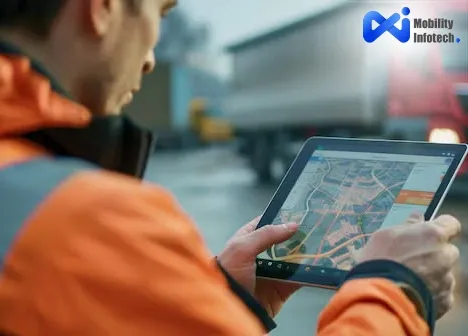
 Written by Michael S.
 Written by David Williams