
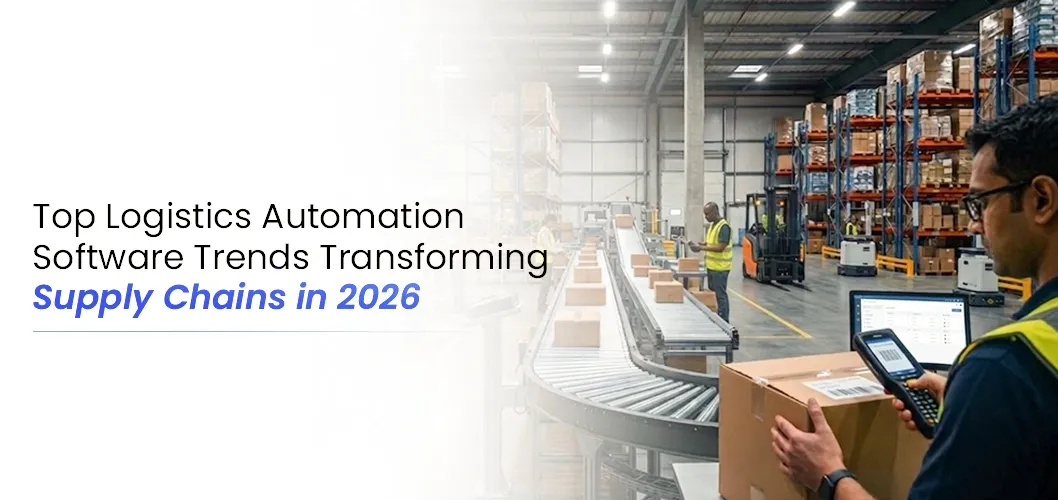
Top Logistics Automation Software Trends Transforming Supply Chains in 2026

Introduction
Trend pieces in logistics tend to age badly because they describe technology rather than pressure. The technology is usually available years before anyone adopts it. What changes is the operating pressure that makes adoption unavoidable.
That is what happened over the last eighteen months in the United States. Volumes kept climbing, carrier options multiplied, operating costs hit records and customer tolerance for vague delivery promises kept shrinking. The result is that capabilities which were considered advanced in 2023 are now table stakes, and last mile routing software has quietly become the control layer for a much wider set of operational decisions.
Here are the six shifts that matter most going into the rest of 2026.
1. Optimization moved from planning to operating
The old model ran optimization once, overnight or early in the morning. The plan was then executed as written, with dispatch improvising around whatever went wrong.
That model is disappearing because the disruption rate has increased. Same day additions, cancellations, appointment changes and traffic variability mean a morning plan is materially wrong within two hours. Continuous last mile route optimization treats the plan as something that lives through the shift, recalculating as position, service time and conditions change. Once operators experience this, going back to fixed daily plans feels like flying without instruments.
2. Volume growth stopped being seasonal and started being structural
The US Census Bureau reported that retail ecommerce sales reached $326.7 billion in the first quarter of 2026, accounting for 16.9% of all retail sales and growing 9.8% year over year, well ahead of the 3.9% growth in total retail. Pitney Bowes projects US parcel volume to reach around 31 billion shipments by 2031, from 23.1 billion in 2025.
That trajectory changes the planning problem qualitatively rather than just quantitatively. A network designed around peak season surge management now needs to handle elevated baseline volume year round, which puts far more weight on the efficiency of routine daily planning.
3. Carrier networks fragmented, so orchestration became a core capability
Pitney Bowes reported that carriers outside the traditional big three more than doubled their share of parcel revenue from 3.4% in 2024 to 7.2% in 2025. Regional couriers, retailer-owned fleets and independent last-mile providers are taking real volume.
For shippers this is good news on price and difficult news on management. Comparing rate, service level and reliability across a mixed network, then assigning each parcel to the right provider, is not something a spreadsheet handles. It is a routing and orchestration problem, and it now sits inside the scope of last mile logistics software rather than in a separate procurement process.
4. Cost pressure pushed optimization from nice to necessary
The American Transportation Research Institute's 2026 Analysis of the Operational Costs of Trucking found the average cost of operating a truck rose 3.4% to $2.336 per mile in 2025, with tolls up 13.2%, repair and maintenance up 8.6% and driver benefits up 6.6%. Its congestion research, published in December 2024, calculated that the industry wasted more than 6.4 billion gallons of diesel in 2022 because of congestion, adding $32.1 billion in fuel costs alone.
When almost every cost line rises at once, the only lever left inside an operator's control is how efficiently the network is used. That is why last mile route optimization has moved from an efficiency project to a margin protection project on most 2026 budgets.
5. Data intelligence replaced reporting
Reporting tells you what happened. Intelligence tells you what to change.
The shift showing up across US operations is from monthly performance decks to operational analytics that feed decisions directly. Planned versus actual service time by location type. Cost per stop by zone. Failure reasons by cause rather than by count. When those numbers flow back into the routing engine automatically, the plan improves every week without anyone running an improvement project.
6. Integration expectations changed completely
Five years ago a logistics platform could reasonably ask customers to export a file. That is no longer acceptable. Operators expect two way REST API connections into ERP, order management and warehouse systems, with status flowing back into invoicing and inventory automatically.
The practical effect is that point solutions are losing ground to platforms. A best in class routing tool that cannot write back into your ERP creates reconciliation work that erases much of the value it created.
What these trends have in common
Every one of them pushes in the same direction. Decisions that used to be made once, by a person, using averages, are now made continuously, by a system, using live data. Last mile routing software is where that shift is most visible because the last mile has the highest disruption rate and the most immediate customer consequence, but the same logic is spreading through first mile scheduling, warehouse allocation and carrier selection.
Why Mobility Infotech Logistics
We have built toward this operating model rather than retrofitting toward it.
The Mobility Infotech Logistics engine evaluates more than 200 constraint parameters across thousands of orders and hundreds of drivers, and it re-optimizes during the shift rather than at fixed points. Planning, execution, tracking and analytics share one data model, so live events improve the next plan automatically rather than through a reporting cycle. Integration runs through REST APIs into SAP, Oracle, NetSuite and Microsoft Dynamics, with low code configuration so operations teams can adjust rules as the network changes.
A vice president of logistics at BlueHarbor Foods in the United States told us that switching to our transportation management system delivered the best return of their year, with route optimization alone cutting fuel spend and driver hours significantly while customers responded well to live tracking links.
What sets our platform apart
- Live re-optimization as standard rather than as a premium module.
- End to end coverage across first mile, mid mile, last mile, warehouse management and shipment tracking on one platform.
- Carrier flexibility, so mixed networks of owned fleet and third party providers are managed in one place.
- Enterprise governance with ISO certifications, GDPR compliance and support for more than 600 brands from offices in the United States, India, Taiwan and Italy.
Where this leaves operators
None of these trends require a five year transformation programme. They require deciding whether your operation runs on a plan or on a system that keeps planning.
The operators who make that shift tend to see the difference first in fuel and driver hours, then in on time performance, then in customer retention. Capable last mile routing software is the entry point, and modern last mile logistics software increasingly delivers the rest of the chain alongside it. If you want to know where your network sits against these shifts, Mobility Infotech Logistics will benchmark your current operation and show you what is available without a rebuild.
- content
- Introduction
- What these trends have in common
- Why Mobility Infotech Logistics
- What sets our platform apart
- Where this leaves operators
Get in touch with our battle-tested sustainability, technology, and TMS specialists to explore tailored green logistics solutions.

You might also like
 Written by Jane Austen
 Written by Michael S.
 Written by David Williams