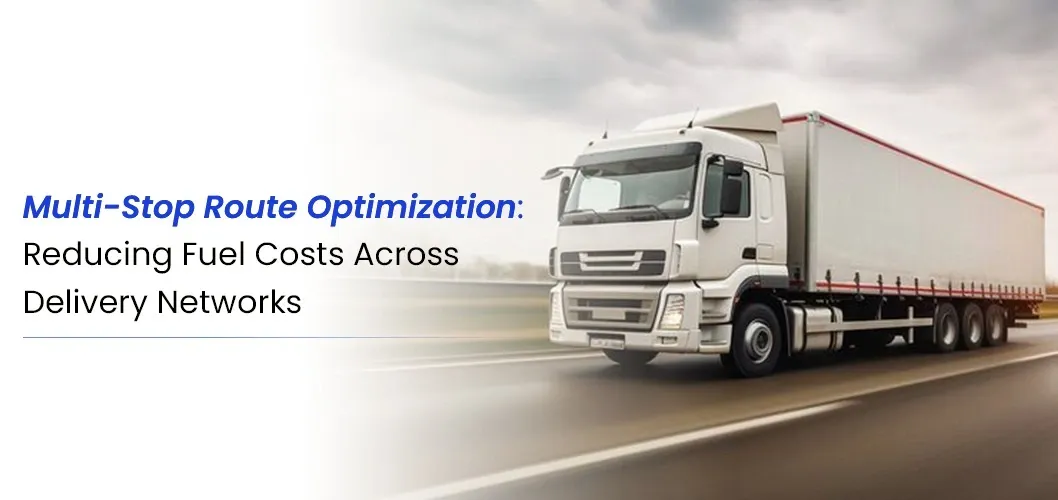
Multi-Stop Route Optimization: Reducing Fuel Costs Across Delivery Networks

Introduction
Ask any fleet manager what keeps them up at night, and fuel costs will almost always come up in the conversation. It is one of those expenses that feels impossible to control, rising and falling with global oil prices while the business just has to absorb whatever happens. But here is the part many companies overlook. A large chunk of fuel spend has nothing to do with oil prices at all. It comes down to how well routes are planned in the first place, and that is exactly where a delivery route planner with multiple stops makes its biggest impact.
Why Multi-Stop Routes Are So Easy to Get Wrong
A single delivery is simple. Point A to point B, done. The complexity explodes once a driver has to hit ten, fifteen, or twenty stops in a single day. The order in which those stops happen matters enormously, yet most manual planning treats stop sequencing as an afterthought rather than the core problem it actually is.
Think about it this way. If a driver visits stops in the wrong order, they might end up driving back and forth across the same area multiple times instead of moving through it in one smooth pass. Multiply that inefficiency across dozens of drivers and hundreds of stops every day, and the wasted fuel becomes a serious number by the end of the month.
How a Delivery Route Planner Fixes the Sequencing Problem
A good delivery route planner does not just list stops in the order they were received. It calculates the most efficient sequence based on location, traffic conditions, time windows, and vehicle capacity, then builds a route that flows logically from one stop to the next.
This is fundamentally different from how most manual planning works. A human planner might do their best with a map and some intuition, but they simply cannot process the sheer number of possible route combinations the way software can. What takes a computer a few seconds to calculate would take a person hours to work out manually, and even then, the result would likely be less efficient.
A Practical Example
Consider a driver with twelve delivery stops spread across a city. Planned poorly, that route might involve 90 kilometers of driving. Planned with a proper multi stop route planner, the same twelve stops might only require 65 kilometers. That is not a small difference. Over hundreds of delivery days in a year, savings like this add up to a substantial amount of money.
The Ripple Effect on Delivery Networks
When individual routes become more efficient, the benefits do not stop there. Entire delivery networks start to function better as a whole. Fewer vehicles are needed to cover the same delivery volume, which means lower overall fuel consumption, reduced maintenance costs, and less strain on the fleet.
There is also a positive effect on delivery speed. Optimized multi-stop routes typically mean drivers finish their rounds faster, which can open up capacity for same-day or next-day delivery promises that would otherwise be difficult to keep consistently.
How Mobility Infotech Logistics Approaches Multi-Stop Optimization
Mobility Infotech Logistics has worked with delivery networks of all sizes, and one pattern shows up again and again. Companies that invest in proper route sequencing consistently outperform those relying on manual planning, not just in fuel savings but across nearly every operational metric that matters.
The technology behind this is not about replacing human judgment entirely. Dispatchers still play an important role in handling exceptions, but the heavy lifting of calculating the ideal stop sequence is handled far more accurately by software designed specifically for that purpose.
Fuel Savings Are Just the Beginning
While fuel is often the headline benefit, there are other cost savings that come along with better multi-stop routing.
- Vehicle maintenance costs drop because engines and brakes experience less strain from stop-and-go inefficient driving
- Driver overtime decreases since routes are completed within normal working hours more consistently
- Insurance claims related to accidents may reduce, since drivers spend less time navigating unfamiliar or poorly planned paths
- Customer satisfaction improves because delivery estimates become far more reliable
Each of these factors contributes to a healthier bottom line, even though they might not be the first thing that comes to mind when thinking about route optimization.
What Makes a Good Multi-Stop Optimization Tool
Not all route planning tools are created equal. A few features tend to separate the tools that deliver real value from the ones that only look good on paper.
- Real-time traffic integration so routes adjust to actual road conditions, not outdated maps
- The ability to factor in delivery time windows so customers get accurate estimates
- Support for vehicle capacity limits, ensuring routes account for how much a vehicle can actually carry
- Simple driver-facing apps that make following the optimized route easy without confusion
A tool that checks all of these boxes tends to deliver the strongest results, since it is solving the whole problem rather than just part of it.
Getting the Most Out of Route Optimization
Simply installing a route optimization tool is not enough on its own. Businesses that see the best results tend to review their route data regularly, looking for patterns that suggest further improvements. Maybe a particular zone consistently takes longer than expected, or a certain time of day sees unusually heavy traffic that the routes should account for more carefully.
This kind of ongoing attention turns a good tool into a genuinely powerful one, since the system keeps getting smarter about the specific quirks of a company's delivery area over time.
A Small Investment With a Fast Payback
One reason more delivery networks are moving toward multi-stop optimization is that the payback period tends to be short compared to other operational investments. Unlike buying new vehicles or expanding a warehouse, which can take years to fully pay off, better routing often starts saving money within the first month or two of use, simply because fuel and time savings show up almost immediately once routes improve.
This makes it an easier decision for finance teams to approve, since the cost of the software is usually small compared to the ongoing fuel savings it generates across a full fleet.
Get in touch with our battle-tested sustainability, technology, and TMS specialists to explore tailored green logistics solutions.

You might also like
 Written by Jane Austen
 Written by Michael S.
 Written by David Williams