
How Multi-Stop Route Optimization Improves Driver Productivity and Fleet Efficiency

Introduction
The 4 AM Problem Every U.S. Fleet Manager Knows Too Well
Picture this. It’s 4 AM in Dallas. A dispatcher is staring at 47 delivery addresses, 12 drivers, and a coffee that went cold an hour ago. Sound familiar? Across America, this scene plays out every single morning. And honestly, it shouldn’t anymore. The route optimization software market is exploding from $8.02 billion in 2025 to a projected $15.92 billion by 2030, and there’s a brutally simple reason why. FleetRabbit
Fleets that still plan routes the old way are bleeding money. Quietly. Daily. Drip by drip. Meanwhile, the smart ones? They’re squeezing more stops, more miles, and more margin out of the same drivers.
That’s the magic of multi-stop route optimization. And here’s how it actually works.
What Multi-Stop Route Optimization Really Means
Let’s keep it real. Multi-stop route optimization is software that figures out the smartest order for visiting dozens, sometimes hundreds, of locations in a single shift. It looks at traffic patterns, delivery windows, vehicle capacity, driver hours, fuel cost, weather, and customer preferences, then spits out a route that a human planner could never match. Not in speed. Not in accuracy. Not even close.
Modern tools handle 50+ stops per route effortlessly, something legacy spreadsheets simply can’t do without errors crashing the whole plan. FleetRabbit
Why Manual Planning Is Officially Dead
Here’s a stat that should sting. The U.S. trucking industry was short roughly 80,000 drivers in 2025, and that gap is forecast to balloon to 160,000 by 2030. TruckClub: When you can’t hire more humans, you have to get more out of the ones you already have. Multi-stop optimization is the only realistic way to do that without burning your team out. Period.
The Numbers Don’t Lie: What U.S. Fleets Are Actually Saving
Numbers tell stories. Big ones. Documented fuel savings from AI route optimization sit at a range of 10 to 25%, with most American fleets landing comfortably between 15 and 20% reduction in fuel burn. FleetRabbit Now consider this. In 2025, U.S. fleets spent an average of $44,327 per truck on fuel at roughly $3.57 per gallon for diesel. Trucker Calculator
Do the math. A 100-truck fleet saving even 15% on fuel? That’s roughly $665,000 back in the bank annually. From software. Just software.
Transportation Cost Cuts That Hit Different
It gets better. Locus reports that fleet route optimization can cut overall transportation costs by 10 to 15% by killing empty miles and pushing vehicle utilization higher. Locus Empty miles, by the way, are the silent killer. A truck driving back half-loaded is essentially a rolling money pit. Optimization software flags those gaps before they happen.
How Driver Productivity Skyrockets
Here’s something fleet owners forget. Drivers hate guesswork. They hate showing up to a customer who isn’t ready. They hate getting stuck behind a school bus on a route they could’ve avoided. Good vehicle route optimization removes that frustration. Routes arrive pre-sequenced on the driver’s phone, delivery windows are respected, and dispatchers stop calling every 20 minutes asking for status updates.
The result? More stops per shift, less overtime, fewer missed deliveries.
More Stops, Same Hours, Happier Teams
When drivers can complete 8 to 12 extra stops per shift, two things happen. The company earns more revenue without hiring. And drivers go home on time. Both sides win. That’s not corporate fluff, it’s what good logistics looks like in practice.
Why the U.S. Last-Mile Boom Makes This Non-Negotiable
The U.S. last-mile delivery market hit $167.36 billion in 2025 and is projected to reach $348.85 billion by 2033, growing at a 9.8% CAGR. Grand View Research. Same-day delivery alone reached $9.25 billion in 2024 and is heading toward $13.15 billion by 2030. SmartRoutes
Translation? Customers expect faster. Cheaper. More accurate. Fleets without fleet route optimization are showing up to a Formula 1 race in a station wagon.
The Customer Experience Multiplier
Here’s a thought. Would you order from a retailer that misses delivery windows twice? Probably not. Optimization improves on-time delivery rates dramatically, and that loyalty compounds. One bad delivery experience can cost a brand a customer for life. One smooth one can earn five-star reviews and repeat business for years.
What to Look for in a Multi-Stop Route Planner
Not all tools are created equal. Some are clunky. Some are gorgeous but useless in the field. The ones that actually move the needle do a few things very well. They handle real-time traffic. They respect delivery time windows. They account for vehicle capacity, driver shift limits, and customer-specific instructions. They integrate cleanly with your existing TMS, WMS, and telematics stack.
And critically? They give drivers a clean, mobile-first interface that doesn’t make them want to throw their phone out the window.
The Mobility Infotech Logistics Difference
At Mobility Infotech Logistics, we build solutions tuned for the realities of American fleets, from regional carriers in the Midwest to last-mile operators along the East Coast. Our platform takes the chaos out of dispatch and puts data, not gut feeling, behind every single route decision your team makes each morning.
The ROI Math Even Your CFO Will Love
Let’s break it down simply. Fewer miles driven. Lower fuel spend. Reduced overtime. More stops completed per driver. Better on-time performance. TrackRoad Each of those translates to dollars saved or earned. Most fleets see ROI within 3 to 6 months of deployment, sometimes faster for high-volume operations. That’s a payback period most CFOs would happily sign off on twice.
The Bottom Line for American Fleets
Here’s the truth nobody wants to say out loud. Fleets clinging to manual planning in 2026 aren’t being traditional, they’re being expensive. The data is clear. The technology is mature. The savings are real. And competitors are already using it to gain efficiency and cost advantages. AI-driven optimization also boosts operational performance, making manual planning an increasingly costly choice.
If you’re running trucks across the U.S. without multi-stop route optimization, you’re leaving fuel, hours, customers, and revenue on the table every single day. Mobility Infotech Logistics is ready to help you stop doing that.
Ready to see what your fleet could actually save? Let’s talk numbers. Reach out to Mobility Infotech Logistics today, and we’ll show you exactly where the inefficiencies are hiding in your current operation.
- content
- Introduction
- What Multi-Stop Route Optimization Reall...
- How Driver Productivity Skyrockets
- What to Look for in a Multi-Stop Route P...
- The Bottom Line for American Fleets
Get in touch with our battle-tested sustainability, technology, and TMS specialists to explore tailored green logistics solutions.

You might also like
 Written by Jane Austen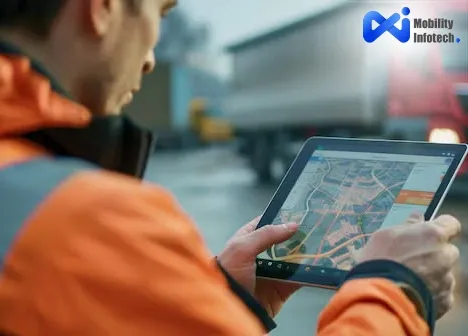
 Written by Michael S.
 Written by David Williams