
Dynamic Route Optimization for Last Mile vs Static Route Planning

Introduction
A lot of fleet managers in the UK and Germany are still running last mile operations off routes that were planned once, maybe months ago, and then reused week after week with small manual tweaks. It works, sort of. Until a road closes, a customer isn't home, or three orders get added after the van has already left. Then the whole plan falls apart and everyone's improvising for the rest of the shift.
That's the core difference between static and dynamic routing, and honestly, it's one of the more important decisions a logistics operation will make this year. With the right logistics automation software, businesses can respond to real-time changes more efficiently instead of relying on outdated route plans.
What Static Route Planning Actually Looks Like
Static planning means routes are built in advance and stay fixed for the day, sometimes for weeks at a time. A planner sits down, maps out stops in a sensible order, and hands that plan to drivers. It's simple, predictable, and for a long time it was the industry standard because there wasn't really an alternative.
The problem is that static plans assume a stable world. No traffic surprises, no late cancellations, no new same day orders slotting in. Real operations rarely work that cleanly, especially in dense urban areas across London, Manchester, Berlin, or Munich where traffic conditions shift by the hour.
How Dynamic Route Optimization Changes the Equation
Logistics automation software built for dynamic routing does something fundamentally different. It recalculates routes continuously, pulling in live traffic data, new orders, driver location, and even weather conditions, then adjusts the plan on the fly rather than sticking to a route that was accurate three hours ago but isn't anymore.
Think of it less like a fixed map and more like a GPS that's constantly rethinking the best path based on what's actually happening right now. When a new urgent delivery gets added mid-shift, dynamic systems slot it into the existing route in the most efficient spot rather than forcing drivers to either ignore it or blow up their whole schedule.
The Fuel and Time Savings Add Up
Static routes tend to accumulate small inefficiencies that nobody notices individually but that cost real money over a month. A few extra miles here, a missed consolidation opportunity there. Dynamic optimization catches those inefficiencies in real time instead of letting them pile up, which is a big part of why fuel and labour costs, already a top concern for over 90 percent of European logistics operators, become easier to control.
Where a Logistics Automation Platform Earns Its Value
A good logistics automation platform doesn't just optimize the route itself, it also handles the operational messiness around it. Driver notifications, customer ETA updates, proof of delivery capture, and exception handling when something goes wrong all need to happen without a dispatcher manually intervening every time. That's what separates a genuinely useful platform from a glorified mapping tool.
This matters even more in markets like Germany, where low emission zone regulations mean route choices aren't just about speed anymore, they're about compliance too. A platform that can factor in vehicle emission class alongside traffic and delivery windows saves operators from accidentally routing a van into a zone it isn't cleared for.
Is Static Planning Ever Still the Right Call?
To be fair, static planning isn't always the wrong choice. For very predictable, low-volume routes with the same stops every single day, the marginal benefit of dynamic optimization can be smaller. But the moment order volumes fluctuate, same day delivery becomes part of the offering, or urban traffic is a genuine variable, static planning starts costing more than it saves.
Most operations we talk to land somewhere in between at first, using dynamic tools for their harder, more variable routes while keeping simpler routes on a lighter touch. That's a reasonable way to phase in the change without overhauling everything at once.
How Mobility Infotech Logistics Supports This Shift
Mobility Infotech Logistics builds its route optimization around real time recalculation rather than a one and done plan. Our logistics application software pulls live traffic, driver, and order data continuously, so UK and Germany fleets aren't stuck reacting to yesterday's map. It integrates with existing TMS and WMS systems, which means teams don't need to rip out what's already working, they just add the intelligence layer that keeps routes accurate as the day unfolds.
We've built this specifically with European compliance requirements in mind too, including emission zone rules, so route suggestions are actually usable rather than technically optimal but practically illegal.
Making the Switch Without Disrupting Operations
You don't need to flip a switch overnight. Start with your most volatile routes, the ones where deliveries get added last minute or traffic is genuinely unpredictable, and run dynamic optimization there first. Once your team sees the difference in missed windows and driver stress levels, expanding to the rest of the fleet tends to be a much easier conversation.
What This Looks Like Day to Day for a Dispatcher
It helps to picture what actually changes on the ground. A dispatcher running a static plan spends a good part of the morning firefighting, rerouting drivers by phone when something goes sideways, apologising to customers whose windows slipped, and manually working out which van has room for a late add on order. It's exhausting work and it doesn't scale well as order volumes grow.
With dynamic routing, most of that firefighting gets absorbed by the system before it ever becomes a visible problem. The dispatcher's role shifts from constant reaction to occasional oversight, stepping in for genuine exceptions rather than every minor hiccup. Drivers get updated stop sequences pushed straight to their app, customers get more accurate ETAs because the system knows about delays before the customer even calls to ask, and the whole operation feels calmer even on a busy day.
There’s a knock-on effect for hiring too. Teams that run lean on dispatch staff, which is common among mid-sized UK and German operators, get more out of each person because the software is handling the repetitive recalculation work that used to eat up hours. Mobility Infotech Logistics supports this shift by helping logistics teams make routing and dispatch operations more responsive and efficient.
Get in touch with our battle-tested sustainability, technology, and TMS specialists to explore tailored green logistics solutions.

You might also like
 Written by Jane Austen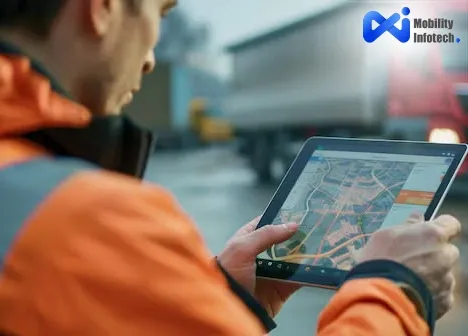
 Written by Michael S.
 Written by David Williams