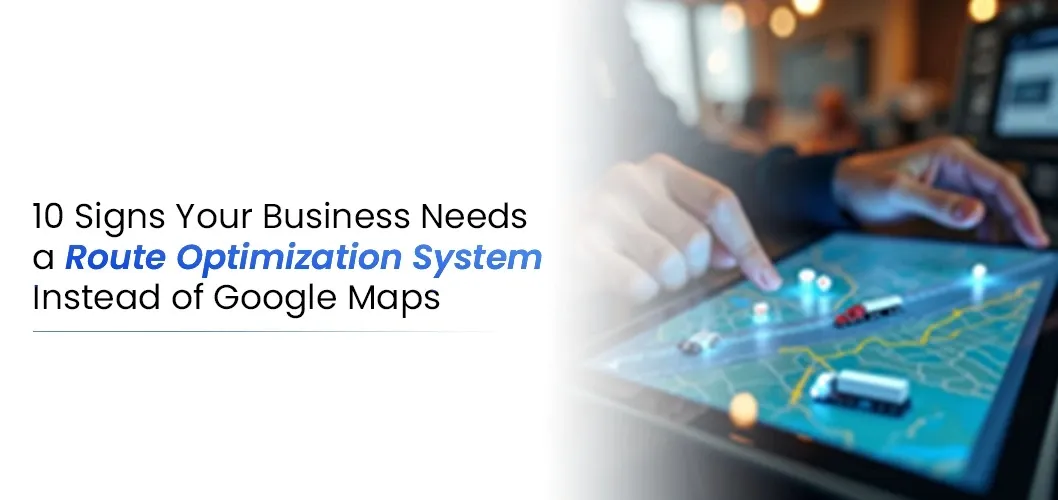
10 Signs Your Business Needs a Route Optimization System Instead of Google Maps

Introduction
Google Maps is an excellent product. It has also quietly become the operations software for thousands of small delivery businesses in the United States, and for a while that works perfectly well. One driver, twelve stops, a phone in a cradle. No argument.
The trouble is that nobody notices the exact moment it stops working. There is no error message. The routes still get driven and the parcels still get delivered. What changes is that the operation starts absorbing costs it cannot see, and the gap only becomes visible when someone finally measures cost per stop or looks at how much of the day dispatch spends on the phone. By then, most operators discover they needed proper routing and final mile tracking software several months earlier.
Here are the ten signs, in roughly the order they usually appear.
1. You are planning routes the night before
If someone is manually deciding which stops go to which driver in the evening, that is unpaid planning labour and it scales badly. It also means the plan is already a day old before anyone drives it.
2. Drivers copy addresses into the app one at a time
Consumer mapping tools optimize a single journey. They do not assign work across a fleet, balance load between vehicles or account for capacity. Every minute a driver spends re-entering stops is a minute not spent delivering.
3. You cannot answer where is my parcel without a phone call
The single clearest sign. If customer service has to call a driver, you have no visibility layer at all. Last mile delivery tracking software exists to make that question answerable in two seconds by someone who is not in a vehicle.
4. Your ETAs are guesses dressed as commitments
A mapping app gives a driving time. It does not know that a particular apartment complex takes eleven minutes to deliver into, or that the fourth stop of the morning always runs long. Without learned service times, every promise you make to a customer is arithmetic based on the wrong inputs.
5. Adding a driver does not add proportional capacity
You hire a fifth driver and completed stops go up by far less than a fifth. That usually means the work is unevenly balanced across the fleet, which is the exact problem optimization engines exist to solve.
6. Failed deliveries have become routine
Loqate's Fixing Failed Deliveries study, published in March 2021 from a December 2020 survey of retail executives, found that 8 percent of first time deliveries in the United States failed, at an average cost of $17.20 per failed order. If your operation is treating redeliveries as a normal cost of doing business, that number is worth applying to your own volumes before deciding it is acceptable.
7. Fuel costs are rising faster than your stop count
Miles per stop is the metric that exposes this. Rising fuel spend on flat volume means routes are getting less efficient, and mapping apps have no mechanism to fix that because they never see the fleet as a whole. Lastmile parcel tracking data is what makes the pattern visible in the first place. The American Transportation Research Institute calculated that congestion caused the US trucking industry to waste more than 6.4 billion gallons of diesel in 2022, adding $32.1 billion in fuel costs, which is the same problem at national scale.
8. Nobody knows what a stop costs
Ask what your most expensive delivery last week cost you. If the answer is an average, you cannot separate profitable density from expensive sprawl, and you are almost certainly mispricing at least one customer.
9. Your best driver is your routing system
Every growing operation has one. The driver who knows the shortcuts, the loading bays and which receptionist signs for parcels. That knowledge is valuable and completely undocumented. Last mile delivery tracking software captures it as service time data at every stop, so it stays in the business. When that driver leaves, a mapping app takes all of it with them.
10. Driver hours keep climbing and so does turnover
Labour is the largest controllable cost in most delivery operations. The Bureau of Labor Statistics reported median annual pay of $57,440 for heavy and tractor trailer truck drivers and $44,140 for light truck drivers as of May 2024. Poorly balanced routes cost money twice, first in paid overtime and again in the recruitment cost of replacing drivers who leave because their days run long.
What changes when you move to a real system
The upgrade is smaller than most operators fear and the difference is immediate in three places.
- Plans are built against constraints rather than distance, including capacity, driver hours, service windows and customer priority.
- Sequences update during the shift instead of being fixed at the depot gate.
- Every stop generates data, so tomorrow's plan is more accurate than today's, which is something no mapping application can offer.
Add lastmile parcel tracking on top and the customer side improves at the same time. Live ETAs, proactive notifications and proof of delivery capture remove most of the reasons customers contact you in the first place.
Why Mobility Infotech Logistics
We work with a lot of operators making exactly this jump, usually somewhere between 100 and 500 daily stops.
The Mobility Infotech Logistics engine evaluates more than 200 constraint parameters across thousands of orders and hundreds of drivers, then re-optimizes during the shift as conditions change. Drivers work from a mobile application with turn by turn sequencing, scan based confirmation and proof of delivery capture. Our final mile tracking software runs on the same data model as the routing engine, so the ETA on a customer link and the ETA in your dispatch view are the same number rather than two estimates that drift apart during the day.
Because we cover first mile, mid mile, last mile, warehouse management and shipment tracking on one platform, growing operations extend what they already have instead of buying a new tool every time volume increases.
What makes us a practical choice
- Fast to start. Most operators pilot one zone within a few weeks rather than committing to a long transformation programme.
- Configurable without developers, so your team adjusts zones, service times and rules as the business changes.
- Integration through REST APIs into SAP, Oracle, NetSuite, Microsoft Dynamics and order management systems.
- Proven at scale, with more than 600 brands supported, ISO certifications, GDPR compliance and offices in the United States, India, Taiwan and Italy.
Knowing when to make the move
Nobody needs a routing platform on day one. The mistake is waiting for a breakdown, then trying to implement new software during peak season with a team that is already stretched thin.
If four or more of the signs above describe your week, the free tools have already been outgrown and the cost is accumulating quietly. Proper routing paired with final mile tracking software removes both the planning burden and the visibility gap at the same time. Mobility Infotech Logistics can run your current volumes through our engine and show you the difference against your existing plan, using your data, before you commit to anything.
- content
- Introduction
- What changes when you move to a real sys...
- Why Mobility Infotech Logistics
- Knowing when to make the move
Get in touch with our battle-tested sustainability, technology, and TMS specialists to explore tailored green logistics solutions.

You might also like
 Written by Jane Austen
 Written by Michael S.
 Written by David Williams